Lenten Practices, 2026
A NEW THOUGHT LENTEN PRACTICE
Create in me a clean heart, O God, and renew a right spirit within me. ~ Psalm 51:10

“Lent” comes from medieval English and simply meant Spring. It is the season for preparing the ground and seeds for planting in Spring. Spring itself is a time of renewal, rebirth, and fertility. That’s why Easter, from the fertility goddess known by names such as Oestre, has bunnies, chicks, and eggs.
Those familiar with the Creative Process symbol know that the middle layer, which represents the Law and the subjective mind, is the filter through which movement of the Ideal nature of Spirit passes into form. We want our filters as clean and clear as possible. We will spend this time with a little spring cleaning to let more of the Light in and through into our lives.
Rev. David will again offer an opportunity to use the season of Lent to go deeper into our spiritual knowing. We will be moving towards experiencing a resurrection of our own as symbolized by Easter and spring. Sign up at cslolyoffice@gmail.com to receive a weekly email for contemplation beginning this Wednesday, Feb. 18th, then weekly from February 22nd through April 5th. You can sign up below for these free inspirational email.
ASH WEDNESDAY 2026
February 18, 2026
Today is honored as Ash Wednesday throughout much of the Christian world. Ashes have long symbolized a humility, a repentance – “turning away from” a path that separates us from the Divine. Our Religious Science motto of “Change your thinking, change your life” is a call for repentance. Throughout both the Hebrew and Christian Bible (a.k.a. the Old & New Testament) there are numerous references to clothing oneself in sackcloth (instead of fine fabric) and rolling in ashes as a sign of remorse for past actions.
Ash Wednesday begins the season of Lent, where people are invited for 40 days to shift their focus from being caught up in putting earthly things first, and change (repent) by focusing on the Divine first. Traditionally, this has been done by giving up something as a symbol of letting go of the old ways and opening to the new, opening to the nature of the Divine.
Often this season has also carried a feeling of guilt and remorse. This is based on the traditional Catholic (and later forms of Christianity) view that we are born sinners. However, in Religious Science, we believe we are all born sacred, incarnations of the Divine. We recognize that we get turned away from the awareness of our true nature through early conditioning, what don Miguel Ruiz calls “domestication” in The Four Agreements.
The real “original sin” is believing that we are separate from the Divine, from Life, from each other, and from our own Divinity. We learn this both through others and assumptions we make about our own experiences. We also begin to experience Life as “not safe.” “Safe” meaning not working out the way we think it should. As I’ve mentioned in several recent talks, we compensate by trying to control Life and this control involves “doing it right” – both for ourselves and others. (i.e. we try to get both to do it our way.) Of course, this doesn’t work, since we can’t control the flow of Life. Rather than realizing the dysfunction of what we are doing, we try to do it harder and better, setting up an endless loop of frustration.
What if… for the 40 days of Lent, we repented by giving up trying to “do it right” and trying to get others to “do it right?” What if… we began to simply observe the flow of Life and be compassionately curious about it? What if… we gave up trying to “make things happen” and instead turned from “my way” to noticing the “High Way?”
This year, for 40 days, I invite us to turn our attention – repent – from what we think is right (which is usually based on our early and often erroneous conditioning) and begin to listen within to that Still Small Voice, and ask, “What is mine to see and know here?” And then listen.
I will be writing a weekly thought each week. (By the way, Lent is traditionally 40 days – a number of significance in early Hebrew culture – but it takes place over 46 days, as Sundays are days off to go to church and listen to the “Word of God” from the priest/minister.) However, I encourage you to find a daily reader to support you in shifting your attention towards your Divine Nature, to help you remember who you really are. Some of my favorites are listed below.
The fulfillment of the Lenten season is the Resurrection – a transformation into a new being and a new way of being. This transformation is always available to us, but we must choose it. I invite you to choose a new, more free, more empowered way of being “in the world, but not of the world.”
Reading suggestions:
- 365 Days of Richer Living, by Ernest Holmes and Raymond Charles Barker
- 365 Science of Mind, by Ernest Holmes
- The Joyous Living Journal, by Revs. Christian Sorenson and Petra Weldes
- The 40 Day Mind Fast, Soul Feast, by Rev. Michael Beckwith
- The Science of Mind, by Ernest Holmes
- Any other “spiritual” or inspirational book read on a daily basis.
LENT WEEK 1: February 22, 2026
Lent is about letting go of attachments that prevent us from deeper connection with Spirit within us. In Buddha’s Four Noble Truths, the first is that there is inevitable suffering in this transient experience of life and second that our attachment (cravings) to trying to keep transient things creates the suffering. The way out is, of course, letting go of clinging. So very easy to do. I’ll let you know if I ever do. 😊
Lent is an opportunity to practice this more consciously. Ernest Holmes points out that if we really believed in the God we say we do, we would be free of unhappiness, illness, and lack. But we have an unconscious resistance to spiritual things. Often, we are unaware of this resistance, and thus make alibis for our lack of good. (From 365 Days of Richer Living, February 13th.)
Recently, one of the guest writers for Fr. Richard Rohr talked about the groups known as the Desert Mothers and Fathers – a group that, in the 4th century, left the established Christian church, which had been taken over by the Roman Empire, thus combining the religion with empire and moving away from Jesus’ teachings in favor of control. They moved out to the desert areas of Egypt, Palestine, Syria, and Arabia. They were described as seeking an interior martyrdom, dying to aspects of themselves that were preventing them from experiencing an intimate relationship with Spirit.
Ernest Holmes observes that “there is a simple way of removing this block” [of resistance to spiritual things.] It is the affirming that God in man dos the work. It is knowing that infinite Mind thinks through our minds at every instant.” This echoes Jesus’ teaching that “The words that I speak, I do not speak of myself; but my Father who abides in me does these works.” (John 14:8) Remember that Jesus is trying to teach his followers his “way.” He’s not saying “stick me up on a pedestal and worship me.”
This week, let’s practice the way of letting go of our resistance to spiritual things. I recently had someone ask, “How can I focus more on the SOM teachings and less on the fears in my mind.” The answer comes back to the old Native American story of two wolfs – one life denying, the other life affirming – and the question of which wolf do we feed. Take time this week to affirm, “Infinite Presence within me does the work. Accept Emerson’s invitation: “Let us take our bloated nothingness out of the path of the divine circuits.”
Enjoy the results of your releasing this week!
LENT WEEK 2: March 1, 2026
One of the powerful processes of letting go of attachments, is letting go of our stories of hurt and the suffering that comes from carrying those stories, like a ball and chain, along our life’s journey. The process of doing this is called forgiveness. For some people, it’s another “f” word.
One of my favorite examples of “forgiveness” is a story not of forgiveness, but of not condemning. In John’s stories of Jesus, the scribes & Pharisees (i.e., the religious establishment, representing our old thinking) brought a woman caught in the act of adultery to him. The old way – i.e., the Mosaic law – said that she should be stoned to death. (It actually says that both the man and the woman – because it takes two – should be stoned to death. But, apparently, by Jesus’ time, they dropped the part about the man.) To test him, and trick him, they asked what should be done with her. In the story, Jesus starts writing on the ground. (John never says what he was writing on the ground. For centuries, the story was made up that he was psychically writing everybody’s sins, but that’s not what the actual story says. I suspect – i.e., the story I’m making up is – that he was writing various of the Mosaic laws that were no longer being followed.) Then told them to let the one f them who is without sin cast the first stone. They all walk away, beginning with the elders.
It’s the next thing that I want to focus on here. Jesus says to the woman, “Did no man condemn you?” She replies, “No man, Lord.” And he says to her, “Neither do I condemn you; go away, and from henceforth, do not sin again.”
He doesn’t forgive her – instead, he doesn’t condemn her. In her book “Revolutionary Agreements” which we have been using this year, Marian Head, under the agreement to honor our choices, asks, “If I truly accept our choices with no judgment, then is there any need for forgiveness?” She goes on to say that forgiveness does have its place, such as forgiving their childhood abuser or a murderer of a loved one. True forgiveness can free us from living in hurt, anger, and resentment for the rest of our lives.
But this also gives us the insight that we only generate a need to forgive when we judge. Just after the story about the woman above, Jesus says to the Pharisees, “You judge according to the flesh; but I judge no man.” As we recognize that all is the Infinite Oneness, there is no one outside of ourselves to judge, nor anything within us to judge. As we recognize that Spirit never makes mistakes, there is nothing to judge as being a “mistake.” As jazz great Thelonius Monk said, “There is no wrong note, it has to do with how you resolve it!” Yes, people do things that hurt us – sometimes terribly. And we do things that hurt others – sometimes accidentally. But if we step back and recognize that each of us always does what we think is the best thing in that moment – bringing in all of our previous living, conditioning (baggage,) experiences, also influenced by present moment conditions (was I hangry, drunk, reliving a childhood trauma, etc.)
But ultimately, we get to ask the question, “Do I want to live and relive that hurt for the rest of my life?” Releasing condemnation, or forgiving, frees us from whatever was done to or by us. We may need to make amends if we have hurt someone. We may have to not allow someone who hurt us back into our lives to do it again. But forgiveness is releasing the energy attached to that wound and choosing to let it heal. Choosing to live in love, peace, joy, and freedom.
This week: Notice if there’s any person or experience toward which you still feel resentment or hurt. Ask your Inner Wisdom Self to help you completely let go of the hurt and resentment. You don’t need to carry that any more. Give it up for Lent.
LENT WEEK 3: March 8, 2026
“Sacrifice” is a word we don’t often use in New Thought, but perhaps we might reconsider. The word comes from the same root as “sacred.” And the essence is “to make sacred.” The first definition in the Merriam Webster dictionary is “the act of giving up something of value for the sake of something else.” One would expect that “something else” would be of greater value.
If we realize that everything is already sacred, we realize we can’t “make” something sacred. Instead, we see it as it truly is – already sacred, already whole. What we give up is our normal way of seeing with all of our judgment, evaluation, and objectifying and instead “see with new eyes.” Paul says that when we are “in Christ” – i.e. in our centered, High Self, we see clearly, as God sees. We do not believe that “Christ” was one person who lived long ago. Rather it is the embodiment of the Divine in all creation. As we become conscious of that embodiment – in ourselves and everything and everyone else – we see each other as we truly are – The Infinite in form.
Lent is traditionally about sacrifice – giving up something. If we believe in a god we have to please through our actions, then we take these actions to please that god “out there/up there.” But we recognize that Infinite Oneness is within and all around and is neither pleased nor displeased by our behavior. Rather, it is in a state of pure Love, Wholeness, Joy, and Peace always. The deeper meaning, the deeper invitation of Lent is to give up our old way of seeing and doing to align with a greater way. To duplicate the nature of Spirit on Earth.
Most of us have seen those optical illusion prints which, if we just look at them normally, seem like a bunch of dots. But, releasing (sacrificing) that surface vision and shifting how we see reveals an image within the dots. In the same way, we are called to see Life in a fresh way, to sacrifice our conditioned way of seeing, based on our old beliefs, and see something else that is already there.
This week: Practice seeing with new eyes. Sacrifice your old way of looking at a situation or relationship, and invite your Christ Within to show you a deeper view. Perhaps taking it into contemplation or prayer, calling forth a greater clarity, a more God-like view, will help you shift your viewpoint to reveal the sacredness already present. Trade your old way for something greater.
LENT WEEK 4: March 15, 2026
Last week we talked about sacrifice. This week, let’s talk about sin and temptation! (I can hear you shouting with glee!!)
In the fifth century, Catholic theologian Augustine (who wrote one of my all-time favorite quotes, “Give me chastity and self-control, but not yet.”) popularized the idea of “original sin,” based on the idea of the fall of Adam & Eve in the second creation story in Genesis, and that we all inherit that fall. Protestant reformers such as Martin Luther and John Calvin insisted that this sin continued on even after baptism (which the Catholics viewed as washing it away) and completely destroyed the ability to do good. Boy, what a happy, joyful outlook on life!!
And it goes completely contrary to the first creation story in Genesis where God is looking at all of creation (including people) and declaring it all good and very good. Considering that we know that there never was an actual Garden of Eden, and that all of this is symbolic, a mythical story, it’s time to let go of any old shreds of this idea that may be lingering in the dark corners of our consciousness.
This week, in one of Richard Rohr’s daily meditation, Father Greg Boyle wrote about asking a young graduate of a Jesuit university about how sin was being talked about now. She replied, “We don’t really use the word ‘sin’ or talk about it. Sin is an Old World map.” How’s that for a new understanding?!
In New Thought, of course, we don’t believe in “sin” either. At most, we’ll call it a “mistake.” I would even go so far as calling it a “learning opportunity.” Since I don’t believe God makes mistakes and we are completely and totally one of God, then we can’t really “make mistakes.” In the eleventh of the Revolutionary Agreements, we are called to look for blessings in disguise. To see the Divine in places we don’t think – by our conditioned ideas of “how it should be” – it exists. If all there is is God, then all we have to do is get our “bloated nothingness” (one of my other favorite quotes, from Emerson) out of the way and see the Divine in front of us.
The period of Lent invokes giving up something and calls for a freedom from normal temptations. This period is based on Jesus’ forty days “in the desert” following his baptism and preceding his ministry. During this time, the inner voice of temptations to go astray – personified as Satan – offered three things – 1. Make bread out of stones to relieve his own hunger (things can get a little hazy after 40 days of fasting), 2. Throw himself off a high place and trust God to save him (how many of us have jumped into a situation hoping it would work and some “god” would save us) and 3. Worship Satan and, in return, receive all the kingdoms of the world – which is an interesting counterpoint to Jesus later teaching of “seek first the kingdom of God and all else shall be added unto you.”
Interestingly, as the Buddha sat under the Bodhi tree, determined not to rise until he achieved full enlightenment (the Buddhist equivalent of Jesus in the desert) he was tempted by the three “daughters” of Mara – the Hindu and Buddhist equivalent of Satan. These daughters represent thirst, (think stones to bread) fear, through a powerful army, and sexual desire, i.e. putting personal desire ahead of God as Source (think worship Satan and you have all the kingdoms.)
Whenever we go for a higher or deeper connection with Spirit, all of our old “temptations” come up, trying to pull us back. (For example, try changing your diet to something healthier, or giving up alcoholism.) Eventually, we have to choose – “get away Satan/Mara”, my calling is more important than this stuff – or give in to the temptations. The practice of giving up something for Lent is intended to strengthen our awareness that we can live without it.
I invite you to look at one of your temptations, one of your “sins” (a place where you feel separate from your Divine Self) and say, “Get out of here, temptation!” or “They had come to him glittering with beauty – Taṇhā, Arati, and Rāga – but the Buddha swept them away, as the wind would to a fallen cotton tuft.”
LENT WEEK 5: March 22, 2026
Because the idea of sin is so pervasive in Western culture, let’s explore it just a little more to help shed any of our old beliefs that are hanging around about it. Sin is a concept in almost all cultures and spiritual/religious traditions, but what it is varies throughout those traditions. Many of us grew up with the Christian concept of sin offending some God sitting up in the sky on a throne, approving or disapproving of our actions. We were taught that we had to appease that God by asking for forgiveness, doing some form of penance, etc. And there was a great deal of shame, blame, and guilt associated with this concept.
As you can guess, that is not the Religious Science concept of sin. We align more closely with the Buddhist view which, because they, like we, don’t believe in a deity, they don’t believe in sin the same way. Instead, they – like we – believe that our deeds set off karmic reactions in an immutable law. Ernest Holmes said that we are not punished for our sins, but by our sins. Our actions carry consequences. But those consequences can be “learning opportunities” if we are willing to pay attention.
The ancient Greek and Hebrew words used in the Bible literally mean “missing the mark.” Contrary to popular mythology, it is not an archery term. But it does call for us to notice when we are missing the mark and correct our actions, or direction.
An aspect I would like us to consider this week is the idea of indulging. We often speak of indulging ourselves, which often means doing something that isn’t really in line with our intended goals or highest aspirations and knowledge. We all need a little pleasure sometime (it has been said, “moderation in everything – including your moderation.”) For my recent birthday, I “indulged” in a chocolate and cream filled pastry – definitely not on my healthy diet.
As an occasional practice, it’s fine. But our culture seems to move more and more towards indulging as a constant. What we’re really doing is filling an empty void with “stuff” – whether that stuff is food, drink, drugs, experiences, shopping, gambling, binge-watching tv, or things like that. As you look at that list, you may recognize many of these as addictions. Addictive behavior always masks unfulfilled needs underneath the surface of our awareness. I know when I’m “indulging,” as a regular practice, on sweets, I’m really craving comfort and I have it associated with certain foods. Sadly, the foods don’t really deliver the comfort beyond a few moments of pleasure – which, because it’s addictive behavior, I’m not even as present with the food as I could be.
All spiritual traditions have a call that Jesus summed up as “seek first the kingdom of God.” The more authoritarian Ten Commandments phrased it as “I am the Lord thy God, have no false gods before me.” When we seek “false gods” of substances and addictive behaviors, we are not seeking the kingdom of god within, we are indulging the world of effects without. That world will never bring us the deep satisfaction we all truly long for.
This week, notice where you’re indulging as a means of avoiding what your soul/Deep Self really wants. When you feel the call, take a breath, go within and ask, what do I really want? Trust me, it’s not that third pastry for the night!! Or whatever your favorite “indulgence” is. What we really want is being present with the Presence.
LENT WEEK 6: March 29, 2026
In the western Christian tradition, today is known as Palm Sunday. It refers to the palm leaves that adoring crowds lay down before Jesus as he rode into town on a young donkey. (Actually, it says they laid down their cloaks – to protect from dust being kicked up by the colt – and a few cut down branches of trees. But, the myth of palms is lovely.)
This could be considered the high point of Jesus’ ministry – at least from a public, human, outer perspective. Of course, we all know how that turned out. He upset the powers of the realm (the empire,) the adoring crowds turned against him, even his own disciples bailed on him, and he got nailed to a cross. And such is earthly fame. (You might look back on your own life and notice where this pattern has played out for you.)
The real high point of his ministry came after – the Resurrection, the conquering of death and the transformation into new form. In that time, as now for many, death was The Big Fear. No one really knows what comes after. Then, as now, there’s all sorts of conjecture and speculation. One of the reasons Ernest Holmes never got into creating statements about the afterlife was he knew that he didn’t know. There’s a Zen story of an aging samurai who goes to a Zen master and asks, “What will happen when I die?” The Zen master says, “I don’t know.” The samurai is a bit taken aback and then outraged and blurts out, “But you’re a Zen master!” The master replies, “Yes, but I’m not a dead Zen master.” He doesn’t know because he hasn’t directly experienced it. Anything else is just speculation.
As we consider this mythical story of what’s known as Holy Week, a week in which Jesus does some great preaching and healing, we might ask ourselves what we have elevated in our consciousness. What is it that we’re proud of for earthly things – such as the old patterns, beliefs, and ideas we’ve treasured and held on to? Things such as our wounding stories (he/she did me wrong! I was abused, abandoned, robbed, etc.) that we have elevated to sacred status within our own minds (and the minds of all the people we’ve tried to convince about them.) And also proud of accomplishments, things we hang our reputation on. (Look at me, I’ve outlasted all the other ministers that have been here. I’ve succeeded where my ex-wife and family claimed I would fail.)
All of these are ideas constructed in our minds. At one point, they’ve been helpful, but now they’re just old stories that keep us from moving forward. Remember the rich young man who asks Jesus what he needs to do to follow him. Jesus to give up all his possessions and follow. Often, our possessions aren’t material things, but beliefs and stories about ourselves – our identity.
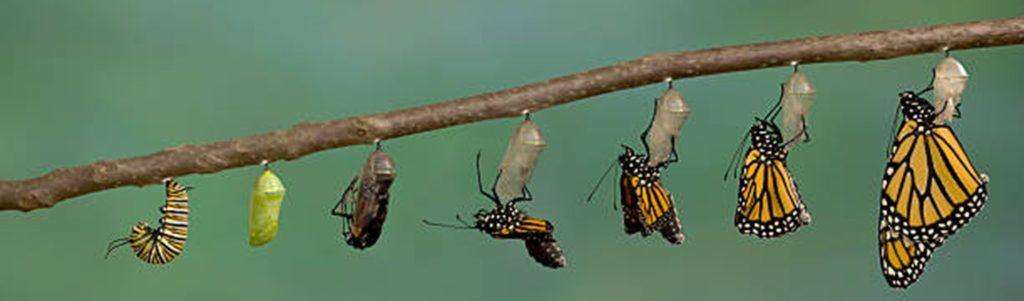
To step beyond our human identity and realize our spiritual magnificence we must die to our old self to transform and resurrect into our new, Authentic Spiritual Self. There’s an old blues song that goes, “Everybody wants to get to heaven, but nobody wants to die.” We all say we want transformation, but we resist the crucifixion of the old self that is required for the new Self to rise. The caterpillar must cease living at the level of caterpillar in order for the butterfly to emerge.
This week, ask yourself, what needs to die within me so that I may be reborn to a new, more wonderful life? As a friend once said, “Hospice what is ready to die and midwife what is ready to be born.”
LENT GOOD FRIDAY: April 3, 2026
CRUCIFIXION
Today is known as “Good Friday” in the Christian religion. It’s the day of the crucifixion of Jesus. As a kid, I always used to wonder why it was “good.” As a Catholic altar boy, I used to follow the priest, swinging the incense burner (called a “censer” or “thurible”) as we walked the Stations of the Cross, focusing on the suffering of Jesus, inspiring guilt and shame among us terrible, unworthy sinners. Boy, am I glad to be free of that B.S.! (Belief System)
Like everything about all 5 Jesus stories, especially the four Gospels, there is great symbolism here. Judaism, like many other cultures, believed in a process called “scapegoating.” The practice celebrated on Yom Kippur (the Jewish Day of Atonement) was to take an “escaping” goat, have the high priest place his hands on it, transferring all of the people’s sins on the goat, which was then beaten with reeds and thorns, and driven out into the desert. The people then went home rejoicing, feeling good and clean for another year.
If you remember your crucifixion stories, Jesus was also beaten with reeds and crowned with thorns, before being killed. And, Christians will tell you he died to carry away our sins. Gee, that sounds familiar. Symbolically, Jesus is humanity’s (or the chosen part of humanity, depending on who you listen to) scapegoat.
But this opens up a whole new can of worms, one that I asked about while still in Catholic school: If Jesus already died for all of our sins forever, then it doesn’t matter whether we sin or not, because it’s already covered. I received a bit of disapproval from the priests and nuns and no real answer. A few years ago, listening to a conversation among some more progressive Christian ministers, I learned that this is an official conundrum for many of their denominations. Some no longer teach that Jesus died for our sins.
We can roll our eyes and talk about the foolishness of people “back then.” But the process of scapegoating – including violence toward an innocent victim – has continued on throughout history and still does today. Heretics and witches burned at the stake. Black people lynched by white people, without any fair trial. And today, we still scapegoat (or want to) with current “sinners” – LGBTQ+ people, immigrants (especially “illegal” immigrants – worst of the worst, according to or president) and, well, the president – the current one, the past ones, the past candidates. And the people who support them, those MAGAts or Libtards. They’re the cause of all evil in the country today and should be driven out! And rich people. Or is it poor people? Or the middle-class people? Or AI and its supporters/opponents.
As long as we “other” – turn our fellow spiritual beings into objects representing our version of “evil” (and “evil” is in the eye of the beholder and changes all the time) – we will look out there for scapegoats to carry our sins, do violence to and drive them away (cancel culture them) in the name of all that is “Good and True, Right and Wrong.” And we will stay bound up in a vicious and unhealthy cycle that does nothing to truly change things.
It is only when we stop projecting evil out onto others (how many innocent black people were lynched for crimes that were later revealed to be committed by white people?) and stop trying to eliminate it out there, and turn within to see where it lives within ourselves (I always loved Pogo’s “We have seen the enemy and he is us”) that we will start making real progress toward a world of greater love, harmony, respect, caring, and working together.
This week, notice where you externalize “evil.” Who or what are your scapegoats? Don’t beat yourself up for it, it’s an ancient human pattern – just become more aware. Then, look within and ask, what needs to change within me to create something better? Take others -and yourself (or aspects of yourself) off that cross and welcome them back into the community of your heart.
LENT HOLY SATURDAY: April 4, 2026
Apparently, Spirit has a lot to say through me. 😊
Today, in Christianity, is Holy Saturday, the day after the death and before the resurrection. I remember Mary Morrissey once asking the question, “So what did he do on Saturday?” It’s a question that’s open to all sorts of speculation, so I’ll speculate. Nothing. He rested. He was complete with the previous life.
But Spirit is always expressing more of Life and, as he rested, that was moving. Just like the flowers don’t make Spring happen, Spring, and the whole nature of the flowers, makes the flowers happen, so Jesus didn’t make resurrection happen – he was resurrected.
As you know, if you’ve been following along so far, this story is an archetypal story, not just about one guy 2,000 years ago. This story is our story. This death of the old and resurrection of the new is a death and resurrection that happens within us as we grow. So, let’s look a little deeper.
Yesterday, I wrote about scapegoating. That Jesus was a symbolic scapegoat for the sins of humanity. And also, that scapegoating is a still very active process in the human mind. But, while scapegoating is still active, so is resurrection. We can scapegoat individuals or even whole groups of people. Yet the spirit of Life still rises. Still resurrects. We know that, no matter how hard you work to pour concrete over your driveway, that pesky little dandelion will still poke its bright yellow head up again.
This is the Rising nature of Life. No matter how put down, seemingly destroyed, or hopeless things seem, Life always rise to something higher. This is the resurrection energy that runs through all of us. We may completely surrender, our hopes seemingly completely dashed into nothingness and death – but there’s still Something moving within, around, and through us. Sometimes we just need to rest and be still long enough to feel It, hear It, let It have Its way through us.
I have long been inspired by this Maya Angelou poem and I leave you with it in the spirit of rising. Wherever in your life things seem hopeless, persecuted, abandoned, betrayed – know that Spirit is still and always rising. I invite you to rise with It!
Still I Rise ~ By Maya Angelou
You may write me down in history
With your bitter, twisted lies,
You may trod me in the very dirt
But still, like dust, I’ll rise.
Does my sassiness upset you?
Why are you beset with gloom?
’Cause I walk like I’ve got oil wells
Pumping in my living room.
Just like moons and like suns,
With the certainty of tides,
Just like hopes springing high,
Still I’ll rise.
Did you want to see me broken?
Bowed head and lowered eyes?
Shoulders falling down like teardrops,
Weakened by my soulful cries?
Does my haughtiness offend you?
Don’t you take it awful hard
’Cause I laugh like I’ve got gold mines
Diggin’ in my own backyard.
You may shoot me with your words,
You may cut me with your eyes,
You may kill me with your hatefulness,
But still, like air, I’ll rise.
Does my sexiness upset you?
Does it come as a surprise
That I dance like I’ve got diamonds
At the meeting of my thighs?
Out of the huts of history’s shame
I rise
Up from a past that’s rooted in pain
I rise
I’m a black ocean, leaping and wide,
Welling and swelling I bear in the tide.
Leaving behind nights of terror and fear
I rise
Into a daybreak that’s wondrously clear
I rise
Bringing the gifts that my ancestors gave,
I am the dream and the hope of the slave.
I rise
I rise
I rise.
EASTER: April 5, 2026
The 40 days of Lent are intended as a transformational period. Human transformation is a combination of human preparation meeting divine movement. In nature, we see the movement of plants, resting, digging deeper roots, allowing the slow-motion movement of winter to happen until the “divine movement” known as changing weather, and a sense of springing forth.
Many of you already know that the word “easter” comes from the pagan (as in earth-based religions) goddess Oestre (who also gives us “estrogen”) who is a fertility goddess. (that’s why we get eggs and chicks and rabbits associated with Easter.) It is the celebration of arising from the dead of Winter into the new life of Spring. Easter is also always tied to the Jewish feast of the Passover, where the Israelites were reborn from slavery in Egypt into their own Promised Land, a new people.
So, this is a celebration of new life – resurrection, rebirth, renewal. The Jesus stories celebrate the resurrection of Jesus from not only death, but being bound into human life. He is, as the old advertisement says, free to move about the planet. But, if we make this celebration about one person a long time ago, we miss what’s really being celebrated here.
Jesus told people he was a way-shower. They were to follow him, not stick him on a pedestal and worship him. And where was he leading? To a deeper understanding of, connection and relationship with God – a God who was a loving father, not a wrathful, vengeful, punishing judge.
As I mentioned in Friday’s email about the crucifixion being a scapegoating process, Jesus did not die for our sins. This journey was to demonstrate the potential of who we all could be. “He who believes in me shall do the works which I do; and even greater than these things he shall do…” (John 14:12) And, in Mark 10:18, “Why do you call me good? There is no one who is good except the one God.”
The entire ministry of Jesus was to shift people’s consciousness about God from the wrathful, punishing warlord to the loving Father within; to the kingdom of God being a political or military kingdom to drive out the Romans to one where love is the only rule. And then to know how to allow this God to work through all of them (us) in the ways that Jesus did – and more. The result of all this? A transformed life. We talk about transformation often in current times, but do we really realize what it means?
It literally means to move across form – to completely change the composition or structure of a form. Most of us want a little improvement, but transformation requires a complete collapse of the old to allow something new to emerge. And that takes courage, commitment, willingness for the old structure – ways – to die so that the new can emerge. The caterpillar ceases to be – though not without a struggle – so that the butterfly can be. The journey is challenging; the results magnificent. Even Jesus knelt in the Garden sweating blood and praying that this experience be taken from him before he finally surrendered.
This week, ask what is wanting to emerge and what must die for that wonderful new existence to be born/reborn/resurrected. And remember, it isn’t you – your human self – doing the work!
Happy Easter!!